
After a dazzling start, teams seem to have found a way to stop Chelsea
When Enzo Maresca’s Chelsea completed a stunning comeback against Tottenham, climbing to second in the league and sitting just one point behind Liverpool, it felt like a turning point. The team displayed fluidity, positional play, and an attacking intent—early signs of a promising project. There was even speculation about an unlikely title challenge, though Maresca himself was quick to dismiss such claims. He maintained that Chelsea remained a work in progress—a statement that would soon be vindicated.
“A lot of teams now come here just to defend and play counterattacking football. That’s very important because now teams start to respect us and maybe they cannot play man-to-man.” — Marc Cucurella
Cucurella’s comments reflect a fundamental shift in how opponents approached Chelsea. In the early months of the season, teams believed they could go toe-to-toe with Maresca’s side, pressing aggressively and committing players forward. This approach played into Chelsea’s hands, as their system thrived in transition, exploiting the space left behind. However, once teams recognized the risks of engaging Chelsea higher up the pitch, they adjusted.
Following the dramatic victory at Spurs, Chelsea found themselves in a favorable position with a seemingly winnable December schedule. Fixtures against Brentford, Everton, Fulham, Ipswich, Crystal Palace, Bournemouth, and Wolves presented an opportunity to solidify their standing. Yet, instead of capitalizing, Chelsea managed just two wins, losing three.

Despite dominating possession and creating chances, they repeatedly struggled to break down deep, compact defensive structures. The low block had become the blueprint for frustrating Maresca’s system. Against proactive teams, Chelsea’s positional play and ball progression flourished. Against deep defensive setups, however, their attacking patterns became predictable, sterile, and ineffective.
Statistical Decline: A Tale of Two Periods
A closer look at Chelsea’s metrics before and after their win at Spurs paints a stark picture:
| Period | xG For | xG Against | Goals For | Goals Against | Possession (%) |
|---|---|---|---|---|---|
| 08/18/24 – 12/12/24 | 2.14 | 2.31 | 1.46 | 1.19 | 56.50% |
| 12/22/24 – 2/09/25 | 1.81 | 1.25 | 1.36 | 1.50 | 61.38% |
| Difference | -0.33 | -1.06 | -0.09 | +0.31 | +4.88% |
Several key takeaways emerge:
- Increased Possession: Chelsea’s possession has risen by nearly 5%, a sign of opponents sitting deeper.
- Reduced xG Output: Their expected goals (xG) have dropped significantly, reflecting fewer high-quality chances.
- Defensive Improvement: While Chelsea now face fewer chances (xGA has decreased), their ability to convert possession into meaningful attacking output has deteriorated.
This article will dissect Chelsea’s struggles against the low block, using their most recent, premier league win against West Ham as a primary case study. We’ll explore key tactical issues—from positional misunderstandings to structural flaws—before evaluating potential solutions, whether through tactical adjustments, player development, or recruitment.
Many Chelsea fans are frustrated with the team’s drop-off in form, leading to harsh criticism of individual players—particularly Nicolas Jackson. However, much of this scrutiny overlooks the tactical context. My belief is that additional pressure from fans does more harm than good. By breaking down the root causes of Chelsea’s struggles, I hope to provide a clearer understanding of why results have changed and why players deserve more patience rather than misplaced blame.
Understanding Low Blocks
Before examining Chelsea’s specific challenges, it’s crucial to define what they are up against.
At its core, a low block is a defensive strategy that prioritizes compactness, denying space in central areas and forcing play wide. Most teams deploying this approach against Chelsea adopt one of two primary structures:
- A five-man defense (5-3-2 or 5-4-1) – Providing extra defensive cover while maintaining width.
- A compact 4-5-1 or 4-4-2 – Focused on horizontal compactness, blocking central progression.
Regardless of the structure, the principles remain the same:
- Minimal space between defensive lines to cut off passing lanes.
- Forcing play to the wings, where quality of chances created are lower.
- Denying space between the lines, restricting key creators like Palmer and Enzo Fernández.
This tactical shift has exposed Chelsea’s weaknesses in positional play and final-third execution. The effectiveness of these low blocks becomes evident in match footage. The following sections will break down these struggles against West Ham in detail, identifying the tactical flaws that have led to Chelsea’s frustrating results.
Positional Superiority
Enzo Maresca comes from Pep Guardiola’s school of thought, where positional play is paramount. At its core, positional play is about creating superiority—whether qualitative, quantitative, or positional. Chelsea excel at gaining numerical superiority and possess players with the technical quality to dominate individual duels. However, where they fall short is in achieving positional superiority—the ability to receive the ball in dangerous areas with time and space to hurt the opposition.
Achieving positional superiority requires precise movement timing, optimal body orientation, seamless communication, and a collective understanding of the team’s objectives. Chelsea, however, have struggled in these areas, often playing into the hands of well-structured low blocks.
Central Dominance
“In both chess and football, the important thing is to control the middle. If you control the middle, you control the rest of the pitch or board.” – Magnus Carlsen
“It’s so important. The guy who plays in the holding midfield, central defense, the strikers, all the positions in the middle of everything are so important.” – Pep Guardiola
The position of the ball on the field fundamentally determines the dynamics of play. Teams that try and play through the middle—commonly known as playing “through the traffic”—have greater flexibility and variety of action, as there are no natural barriers restricting movement or passing angles. A player in the middle can play the ball in virtually eight basic directions: forwards, backwards, left, right, top right, top left, bottom right, and bottom left. In contrast, a player on the wing is limited to five options, as the touchline eliminates passing possibilities on one side. This gives them a tactical advantage but also presents challenges due to the higher concentration of opposing players in central zones.
The middle of the pitch serves as the primary link between all areas of the field. Teams that aim to dictate possession must prioritize central dominance, but this zone is often heavily congested. Most defensive structures are built to protect the middle because allowing easy progression through central areas gives the opponent direct access to goal. As a result, central players must operate at a high speed of thought and action. They need to scan in 360°, as pressure can come from all directions, whereas players on the flanks only need to scan 180°.
“The idea (or intent) is to have an overload in the middle and always try to find the extra man.” – Enzo Maresca
Positional superiority plays a crucial role in achieving central dominance, and this remains a significant area of concern for Chelsea.
Take a look at this clip:

At first glance, it might seem like Chelsea are in control. They are circulating the ball outside West Ham’s low block. However, West Ham are content with this scenario—they have successfully forced Chelsea into harmless possession. At one point in the clip, Chelsea have four or five players positioned behind West Ham’s first line of press. This means that the remaining five Chelsea players are surrounded by West Ham’s entire 11-man defensive structure. When Chelsea attempt to step into the block, West Ham nullifies them with ease.
Let’s break this down and analyze how Chelsea could position themselves better to break West Ham’s block.
Chelsea build in a 3-4-3 shape, with the midfield four forming a diamond—Caicedo as the anchor, Palmer at the tip, and Cucurella and Enzo Fernández on either side. West Ham have five defenders, two pivot players, and two tucked-in outside midfielders, forming a 5-4-1 defensive block.

From a static perspective, West Ham have the numerical advantage in midfield. Maresca’s intended overload has been nullified. To create an advantage, Chelsea must move West Ham’s midfield block to disrupt its shape and exploit gaps. This is where Chelsea fail, and it ultimately costs them control of games.
It’s important to note that West Ham’s defensive block is not positioned particularly deep. Chelsea not only need to bypass the first two defensive lines but also a back five before accessing the high-value space between the defense and goalkeeper. Furthermore, Chelsea have committed five players behind West Ham’s first two lines, meaning that if they lose possession, West Ham are in a stronger position to counterattack. This scenario places Chelsea at a disadvantage despite having the ball—West Ham are controlling the game without possession.
Caicedo’s Role and Chelsea’s structural issues
Now, let’s examine a key issue in Chelsea’s buildup play.
- Caicedo drops deep to receive the ball in front of West Ham’s first line, while Palmer moves behind West Ham’s second line.
- As a result, Chelsea have no players positioned between West Ham’s first and second defensive lines.
Caicedo’s decision to drop is the first mistake. Chelsea already have three defenders against West Ham’s lone striker, Bowen. There is no need for Caicedo to drop deeper, as it removes a potential progressive passing option between the lines. If the ball is to reach the attackers, it now requires a direct pass that somehow bypasses two defensive lines. The following visuals illustrate this concept:


For a team that operates with a single pivot and wants to progress the ball into the final third, their defensive midfielder must remain positioned behind the first line of press. The reasons for this are:
- Providing a passing option between the lines from CBs.
- Staying closer to teammates.
- Manipulating the opposition’s defensive structure.
First and second point are easily explainable. Third point is where it gets tricky.
Manipulating opponets
“The holding midfielder has to be there, and not move. Like if you drive a car and move to the backseat, you can crash. The driver has to be there, in the front.” – Pep Guardiola
“We pass the ball to move the opponents, not the ball.”
Guardiola compares the holding midfielder to a car’s driver, but a more fitting analogy might be the rod bearing of an engine—a crucial yet overlooked component that ensures smooth movement under immense pressure.
Let’s compare this situation to a similar scenario from the 2023 Champions League final, where Manchester City executed their buildup play much more effectively against Inter Milan’s defensive block.
City used a 3-diamond 4-3 structure, with Rodri as the anchor, Gundogan at the tip, and Stones and De Bruyne flanking them. Inter, like West Ham, defended with a five-man backline and a compact midfield.
Pay attention to the following 3 things:
- Rodri receives between first line, then carries until Dzeko’s attention is caught.
- Rodri’s backward diagonal pass to Ake
- Rodri moves wider between Inter’s two lines.
- Gundogan drops to space created by Rodri’s movement.
Rodri carried the ball till Dzeko fully turned his body away from Ake, giving Ake more time and space. He then makes a diagonal pass back which does two sutble but very important things. It first forces Barella to come out of his line and put pressure on the carrier. Secondly, it gives him time to jog and arrive in position with information having scanned and analyzed all possible outcomes. Rodri then positions himself behind Barella and Dzeko, in order to receive and turn away from both pressure points. From there, he could either carry forwards, or play to Kevin de Bruyne who had space in front of him to exploit.
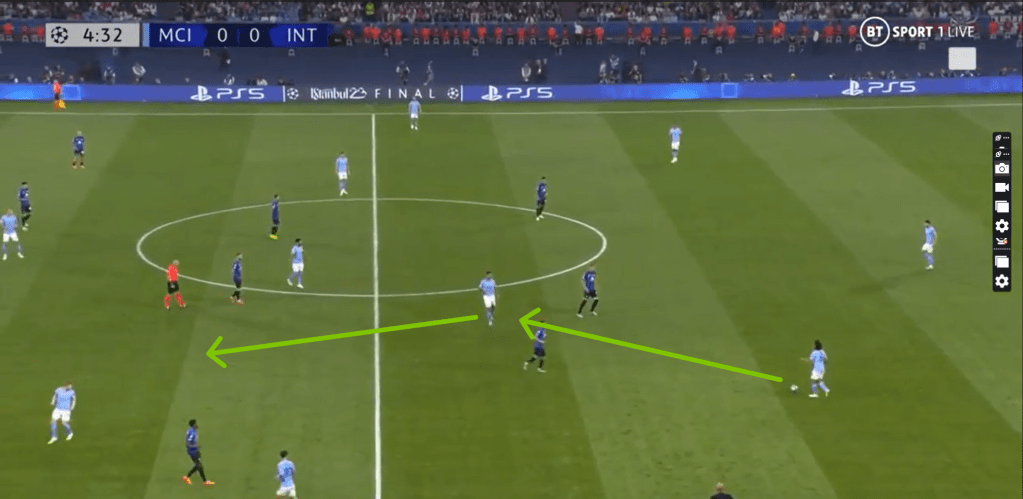
Ake decided against the pass and favored recycling the ball back. From here Gundogan is able to drop and receive in the zone Rodri vacated. City had gained the overload in the middle, and were able to now play behind the pressing point and exploit gaps. All of this was made possible by Rodri positioning himself behind the first line.
Rodri carry moved Dzeko away from Ake. Rodri’s pass to Ake moved Barella out of position. His new position moved Dzeko out of the center, which created the gap for Gundogan. Everything he did was intentional. They passed the ball to move the opponents.
Now, compare this to Chelsea’s clip:
Now, compare this to Chelsea’s clip:
- Caicedo receives the ball behind West Ham’s first line and carries forward to engage Bowen.
- However, instead of repositioning, he plays a pass to Tosin and fails to move behind the first line.
- By the time he corrects his positioning, Chelsea’s play has already shifted toward the right-hand side.
I want you to notice the intent of Rodri, and compare it Caicedo. Everything is done quickly, but subtly. His pass backwards, then jogging while scanning to get to position. By the time he is in position, he has the information on where the pressing points are, and where he will play the ball next.
Compared to Caicedo. Attracts Bowen then plays to Tosin. He then stutters to the right position, not paying attention to the ball, or his teammates positioning. He wasn’t scanning or looking for where to play next.
All those signs point to the play dictating his positioning and actions; rather his positioning and actions dictating the play; like Rodri. He should be arriving at his next position at the same time Colwill is ready to play the ball; just as Rodri arrived at just the right time for Ake to play the pass.
In the same clip, we can see Caicedo being dictated by play instead of dictating the play. At around 13:48, you can see Caicedo and Tosin engaging in a conversation. Tosin points to Caicedo to move behind the first line of pressure, and help connect midfield and attack. Caicedo first insists on staying deep, and by the time he realizes he is in the wrong position, it’s already too late!
“When accessing all information is common, paying attention to important information is rare.”
First, we see Caicedo being directed by Tosin to move behind the first line. Once positioned right, he barely scans to see how he can influence the game further, or better said, dictate play.
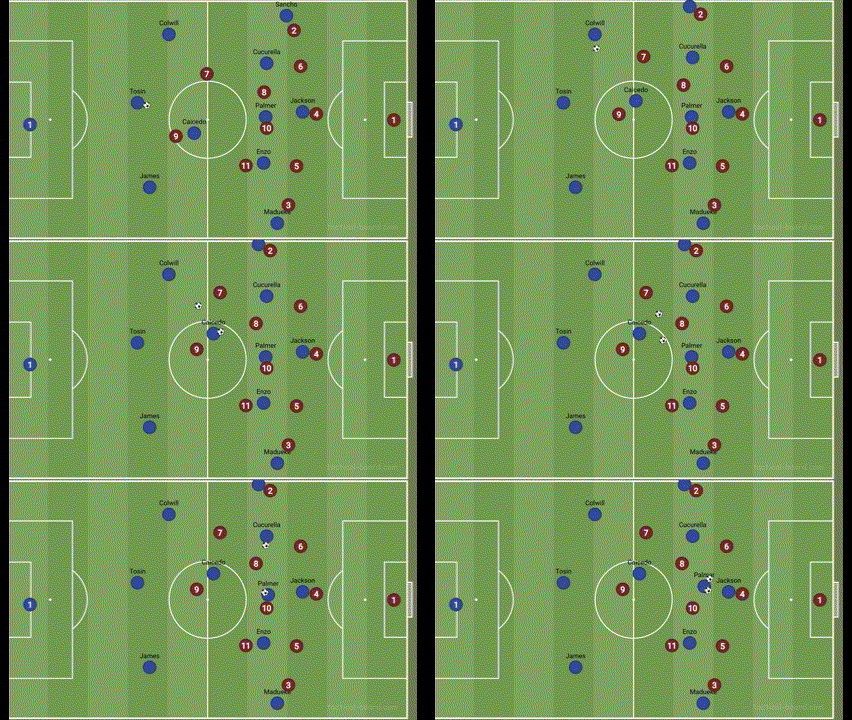
If the connecting link can’t seem to find any links to the final third, the ball simply won’t get to the final third. A number 6 for the team, not only has to be there in the driving seat as the driver, he also has to drive the car.
“When I first met the club for the first time, he was the first name I told them. He was the main player because, with our idea (or intentions), Harry is an unbelievable player.” – Enzo Maresca on Harry Winks
Harry Winks undoubtedly had his best year of soccer under Maresca. While he struggled for consistent gametime under previous managers, Maresca’s vision allowed Winks to flourish, proving how important a dictating number 6 can be. Let’s break down why.

As the ball moves between teammates, Winks is constantly scanning for information. When the ball is played to him, he intentionally takes a negative touch to draw the opposition midfielder out, enticing them to press him, and only releases the pass when the opponent is drawn far enough. From here, he passes the ball back and repositions behind the space he’s just created by moving the opposition. This movement opens up avenues for Leicester to play through the midfield and bypass the first two lines of pressure with only three passes.

This next clip should be broadcasted at every art convention.
At the start of the clip, Winks directs the goalkeeper to come out. He also instructs Faes (RCB) to move wider to help create space for the goalkeeper. Despite Faes’ movement, the goalkeeper hesitates to come out, so Winks takes matters into his own hands, passing the ball directly to the goalkeeper. From here, Leicester reposition and seamlessly play through the press.
This, by definition, is dictating play. Winks has a picture in his head of how to beat the press and then executes it. Without him, Leicester would have kept possession but struggled to progress into the final third.
Just to clarify, I am not claiming Harry Winks is a better player than Moisés Caicedo. Rather, I’m using Winks to highlight the crucial role of the number 6 in a positional play side. If your six isn’t consistently thinking about ways to access the final third, it becomes a challenge to get the ball there. This, in turn, limits your opportunities to score goals.
This is an area where Caicedo has room for improvement. While he has shown flashes of being able to dictate play, his current level in this specific area lags behind what Chelsea desperately needs.
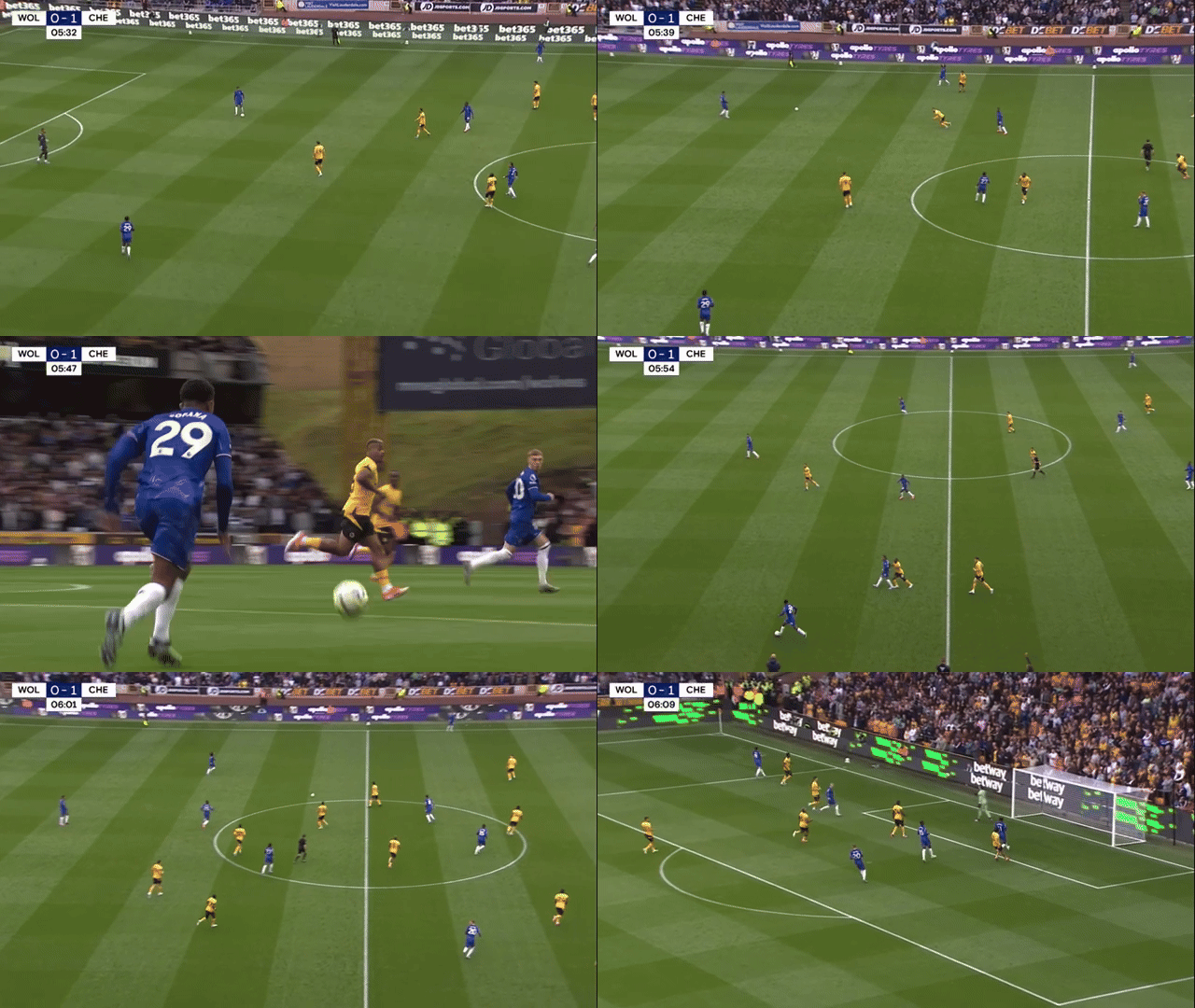
“He’s doing well, especially off the ball. But he can do much, much, much better on the ball.” – Enzo Maresca on Caicedo
Innefective movements
While having control in the central areas is an important step forward, movement is the key to making that control truly effective. When players lack timing, direction, or purposeful off-the-ball runs, the game quickly becomes stagnant, and the low block stays intact. The opposition is more than willing to stay compact and prevent any space from being created.
Take the following clip as an example:
Chelsea are building from the back in a 3-Diamond 4-3 formation

Once again, there’s nothing inherently wrong with this setup. Chelsea maintain possession and generate a shot, which nearly results in a corner. However, West Ham are content with this. If they can restrict Chelsea to these types of low-probability chances, they’ll consider that a success.
Against deep blocks, we often see this type of possession circulation among Chelsea players, but it fails to open up passing lanes or create gaps to exploit. This aligns with what Maresca has discussed in his conferences and interviews; the issue here lies in the gap between intent and execution.
To understand what Chelsea are trying to do, we need to look for recurring patterns. In this clip, one clear pattern is the movement of Cucurella and Enzo—whichever player is closest to the ball drops deep, while the other moves between the lines. This often sees them dropping into the fullback zone, just in front of West Ham’s pressing line. We’ve seen this throughout the season, regardless of personnel.
I’m not a fan of this pattern, as it takes players out of positions where they could hurt the opposition. It also minimizes the involvement of the wingers in the game.
Proposed Solutions to Break the Stagnation
One potential solution would be to switch the roles of the players dropping deep. If the far-side midfielder drops, while the nearer midfielder pushes up, it would open up the passing lane from the outside centre-back to the winger in a 1v1 situation. This also forces the opponent’s backline deeper, as the midfielder makes a run toward them. The defenders would have to react and adjust accordingly.

A negative vertical pass from the outside centre-back (RCB) to the central centre-back (CCB) often triggers pressing from most teams. This pass allows the low block’s defensive line further from goal and forces the opposition into a trap, usually out wide where passing options are limited. From there, Chelsea can use rotations and movements to beat the trap.
The opposite movement—where the outside midfielder moves up and the winger comes short—would disrupt West Ham’s ability to keep Chelsea static. The movement forwards forces the defensive line to drop, whilst the forwards/midfield are focused on pressing. It creates gaps to exploit; 1v1 with the winger, who now has space to cut in, or direct balls to players further up.
I noticed in this game that Enzo Maresca specifically instructed Marc Cucurella to adjust his movement, which gives me reason to believe his intentions align with my suggested solution.
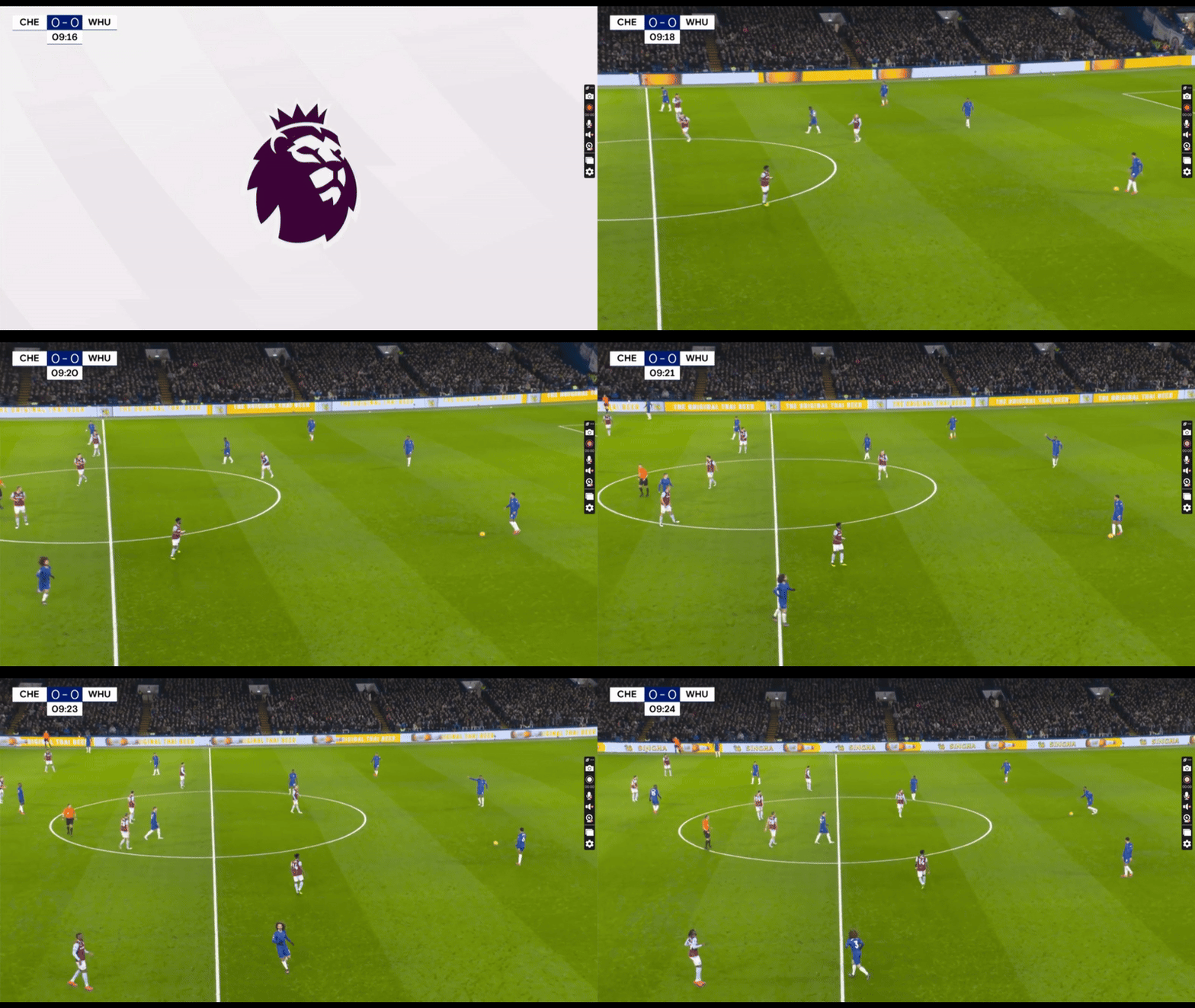
However, this has been a recurring issue throughout the season. Here’s an example from October, when Chelsea hosted Nottingham Forest at Stamford Bridge.

If you closely examine the clip, you’ll see Levi Colwill directing Enzo to push up. Just three minutes later, a similar sequence occurs, but Enzo holds his position, and Sancho drops instead.

Colwill’s instructions to Enzo reinforce my belief that the game plan is not for the two midfielders to drop deep.
Addressing this issue has been challenging. I want to believe this isn’t part of Maresca’s tactical instructions, but it happens so frequently that it seems intentional. If it is indeed an instruction, it’s one that must be reconsidered. It leads to excessive sideways passes and prevents Chelsea from entering the final third with either positional or numerical superiority.
If Maresca is set on maintaining this approach, perhaps shifting the wingers inside could be an alternative. The opposite movement—where the midfielder moves wide and the winger moves inside—would force the opposition to adjust their positioning. The opponents outside centre-back would be forced to track the midfielder’s coming short, while the wing-back follows the winger inside. The opponent could try swapping markers, with the wing-back following Chelsea’s midfielder, while the outside centre-back tracks the winger’s movement. Both scenarios create chaos that the opposition won’t find comfortable.
Though Chelsea could potentially exploit both of these situations, the probability of sustained success is questionable. In my view, a more sustainable solution lies in abandoning this tactical instruction altogether.
Final third: The Bigger Picture
Chelsea have issues with their build up and midfield, however, it would be unfair to place all the blame here without considering the problems they face in the final third. Chelsea miss a lot of chances—and the stats certainly support that. But is it only about missed chances, or is the deeper issue about creating the right chances?
Let’s consider some key stats:
- West Ham: 22 shots, 2 goals, 1.67 xG
- Wolves: 19 shots, 3 goals, 3.20 xG
- Crystal Palace: 15 shots, 1 goal, 1.24 xG
- Fulham: 14 shots, 1 goal, 1.78 xG
- Everton: 12 shots, 0 goals, 1.17 xG
These stats indicate that Chelsea are not scoring as many goals as their play suggests they should, but they also tell us something else: the chances created against deep blocks are often limited in terms of quality.
Chelsea’s Offensive Shape and Why It Struggles:
In deep-block situations, Chelsea’s system seems to take away a key attacking player from each line (defensive, midfield, attacking midfield). This means when the ball reaches the final third, Chelsea often face one fewer player than the opposition. With less time, less space, and fewer teammates to combine with, it’s no wonder that creating clear-cut chances becomes increasingly difficult.
To combat this, Chelsea funnel the ball wide to their wingers, who either cut inside to shoot/carry, or, mainly, attempt crosses.
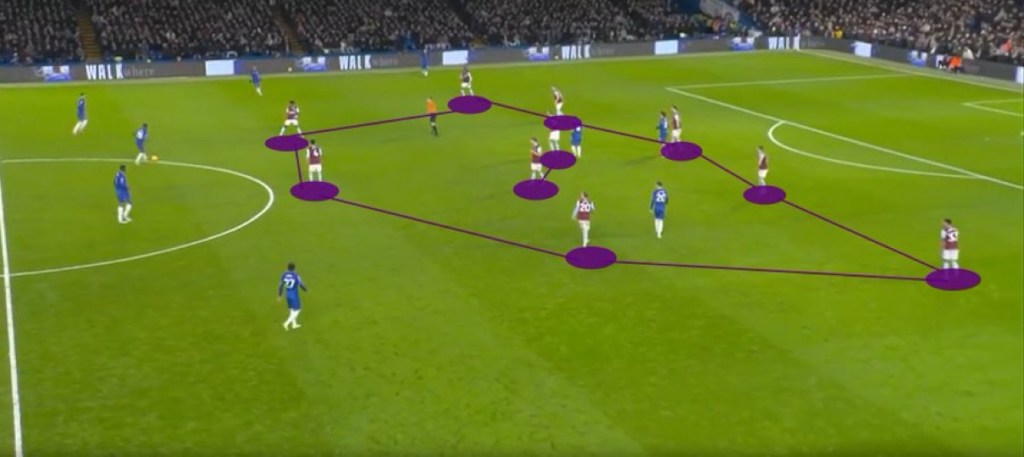

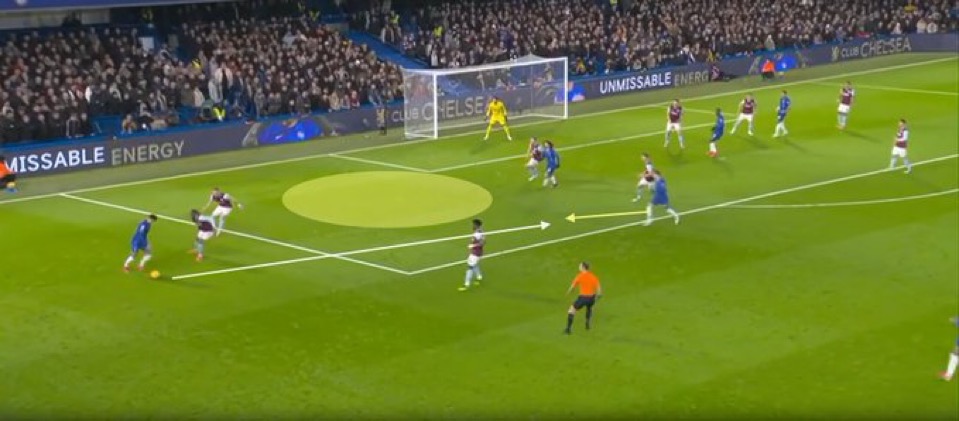
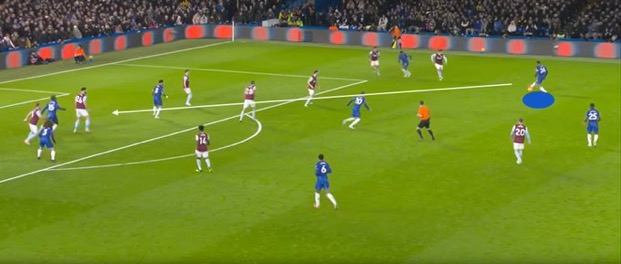

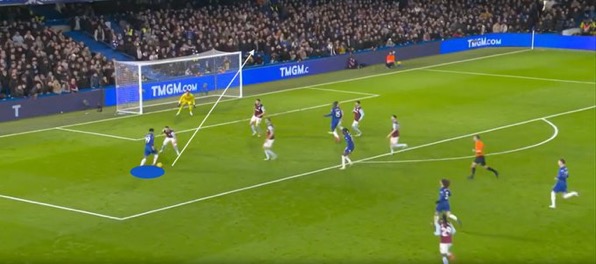

Pic credits: @Fahdahmed987 on twitter!
While this method does bring the ball into the box, it’s not as effective as it could be, especially with Chelsea’s personnel issues:
- Chelsea’s Height: They rank 17th in the Premier League for average height. This puts them at a disadvantage in aerial duels, which is a problem when relying on crosses.
- Personnel Strength: Chelsea’s attackers, like Jackson, Palmer, and others, are not particularly suited to winning aerial duels. Jackson is a strong target but doesn’t consistently benefit from this style of play.
While crossing and relying on physicality may not be the ideal solution for Chelsea, there are alternative approaches that could be far more effective. Chelsea’s strength lies in their technical players, many of whom are exceptional at quick, short passing and rotating off the ball. By focusing more on their technical superiority and retaining possession, Chelsea can proactively force opposition defenders into mistakes—something that a direct aerial battle won’t necessarily achieve.
Chelsea can compete technically with best in the world. However, globally, teams that can’t match up technically, won’t compete technically. They know Chelsea are superior. They turn the game into a physical game, which heavily favors them. Chelsea must recognize that when teams try to disrupt their technical superiority, the worst thing they can do is fall into the trap of turning the game into a physical battle. By relying on crosses, long balls, and aerial duels, Chelsea plays directly into the opponent’s hands—a game they are less suited to win. My suggestion to Chelsea would be to try and keep the game a technical game. Let’s see how they can do so!
“We were so smart to not make quick actions and not concede faults. The long balls, crosses, first and second balls are all faults. I told them don’t touch them, don’t touch them! This is good because the game continues, continues and continues. At the end we could’ve scored.” – Pep Guardiola after playing Arsenal in September
Don’t give the opponent what they want. You play into their hands by changing the game from a technical one to a physical one. It becomes a game of who is physically superior. If you keep playing, and playing, and playing, don’t cross, don’t give them easy possession; just play the ball, your opponents won’t be able to compete. Don’t fight fire with fire. Keep control, slow the game down, and maintain technical dominance. Teams will eventually cave in because:
- They need to score as well
- They will be forced to
Point one is simple. You can’t win a game without scoring and you can’t score without having possession of the ball. Also, there’s very few things that is more mentally and physically draining than defending. It drains a player as they constantly have to react to each new ball position. If a 5 yard is played, they have to readjust their positioning based on the new location of the ball. Keeping the ball in play means that you are preventing the defending team from resting.
Point two is a little bit more complicated.
As we discussed earlier, Chelsea don’t arrive to the final third well. They tend to be one less player down, and with less space than intended. If Chelsea fix their build up like we talked about, and arrive in the final third with the right conditions, they can proactively force mistakes out of the opponents with short passes, movements and rotations. The mistakes tend to be a player stepping out of their zone to follow a player.

Things to pay attention to:
- Kovacic moving behind Arsenal’s first line of press
- Gundogan moving to the box
- Space for Silva to receive
In this clip, Arsenal, down to 10 players, defend with two compact lines (5-4-0). Kovacic, City’s 6, moves behind Arsenal’s first line of defense. This movement forces Arsenal to retreat, while City can set up a potential overload on the right side. With players like Gundogan, Kovacic, Savinho, and Silva all positioned between the two Arsenal lines, City now have the advantage of numbers, which can be exploited by threading the ball into any of these players.
Akanji passes wide to Savinho, forcing Arsenal’s widest defender to leave Silva and engage with Savinho as an immediate threat. This is crucial: by making Savinho the focal point, Arsenal is forced to react to potential 1v1 situations, block a shot, or cut off a cross. Martinelli drops and covers Silva. Meanwhile, Gundogan makes a run into the box, drawing Gabriel away from his position to track him.
However, Savinho decides not to carry or cross the ball, instead passing it back to Walker. Now, Arsenal’s Martinelli must step up to deal with Walker’s threat as a crosser. This opens up space for Silva, who is now in a prime position to receive a pass.
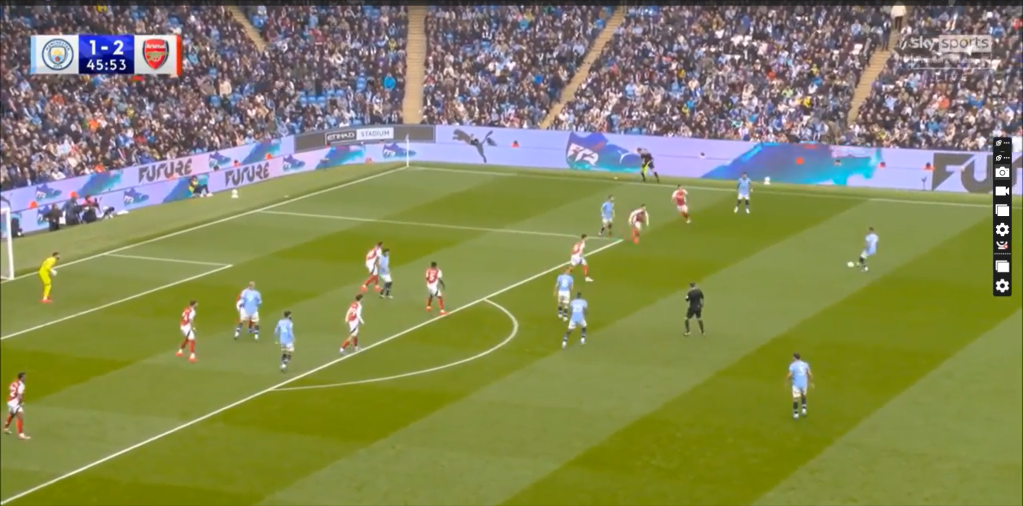
This scenario encapsulates what Pep Guardiola refers to when he talks about avoiding crosses, long balls, and second balls. While City had numbers in the box, crossing wasn’t the best option. Arsenal’s defense, with their tall defenders and midfielders, would be ready for that predictable delivery.
“This is good because the play continues.” The real opportunity arises when the game stays technical. A small, decisive 3-5 yard pass from Walker to Silva in a shooting position is far easier to execute and more dangerous than a cross into a crowded box.
“A back pass does not indicate fear, but the beginning of another, better play.”
Chelsea has players who are more than capable of playing such small yet decisive passes—players like Enzo, Reece, Caicedo etc. who all thrive in tight spaces and can unlock defenses with delicate passes. If Chelsea can create similar scenarios, where they flood the final third with technical players capable of quick passing and off-the-ball movement, they’ll find more success breaking down deep-blocks.
However, the challenge lies in how Chelsea enters the final third. The team’s issues stem from further back, where their build-up play and decision-making haven’t consistently set up these kinds of attacking sequences.
Conclusion
I urge Chelsea fans to be patient. Building a system with heavy positional play principles takes time, especially with a squad so heavily focused on youth. Just like when Pep Guardiola first arrived at Manchester City, there will be growing pains. It took City a season, then several more, to fully integrate Pep’s ideas and reach their prime. Chelsea’s recruitment strategy, focused on young players, brings both advantages and drawbacks. The lack of experience is a significant factor, as many players are encountering a system with heavy positional principles for the first time.
With time, these players will develop the understanding necessary to execute Maresca’s vision. Just as Rodri had his struggles when joining City, Caicedo will improve and adapt. If Chelsea stays patient and continues to invest in their long-term development, the team will eventually thrive. Time, in the end, will favor Chelsea.
 myworkspace
Leave a comment